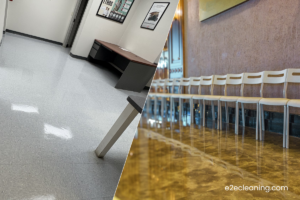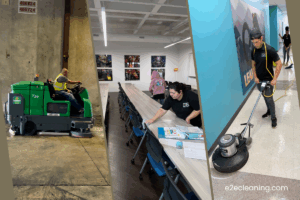
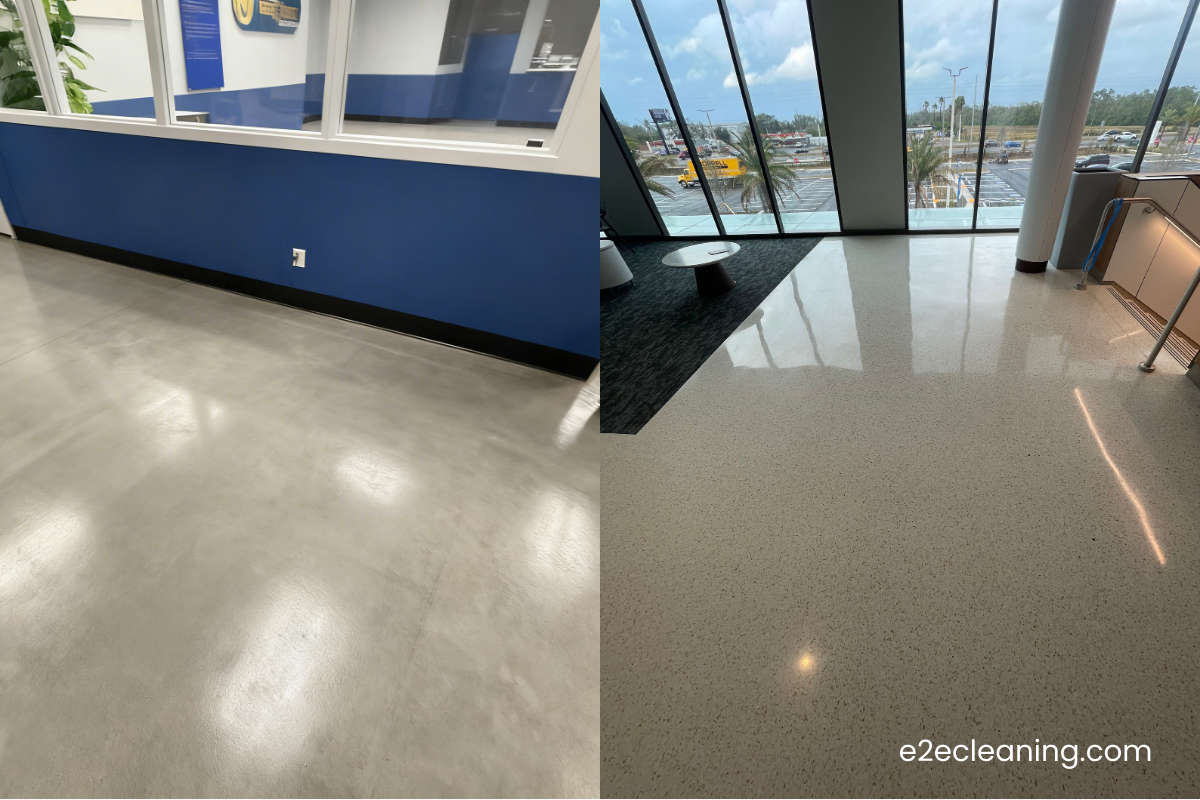
For good reasons, the majority of Florida facilities opt for polished concrete or terrazzo. Both are professional, long-lasting, and designed to handle heavy traffic. On paper, the installation cost makes sense.
The reality of maintenance is what emerges later.
Particular attention is required for both floors. Without it, both can deteriorate quickly. Additionally, neglecting that care not only delays the issue but accelerates it in Florida’s circumstances.
Here are the actual requirements for each floor, the annual cost, and the areas where most commercial spaces fall short.
Key Takeaways
- Polished concrete works with your current slab, costs less each year, and is easier to keep clean, but you have to reapply the sealer.
- Terrazzo needs special cleaning products and professional polishing once a year. If you don’t do this, it will cost a lot of money to fix.
- The humidity, moisture vapor, and foot traffic in Florida wear down both surfaces faster than in drier places.
- The most common cause of floors getting damaged too soon is using the wrong cleaner, which is also the easiest to avoid.
- When taken care of properly, both floors are long-lasting and easy to clean. If not, they both become costly problems.
- Polished concrete is better for annual maintenance costs, but terrazzo is better for long-term lifespan and design value.
What Each Floor Actually Demands
To know what kind of maintenance the surface needs, you first need to know what it is.
Polished Concrete is your current concrete slab, treated with a chemical densifier, and polished to a smooth, long-lasting finish. There isn’t a coating on top, so there’s less to strip and reapply, but the sealer still needs to be taken care of all the time to work.
Terrazzo is made by mixing marble chips, granite, or other aggregates with portland cement or epoxy, then grinding and polishing them to a high shine. It’s one of the most beautiful and long-lasting types of commercial flooring, but to keep that polished look for a long time, you need to use certain products and get professional help.
Compared to tile or carpet, both are easy to care for. Neither one is free of upkeep.
The Products That Damage Each Surface
Most in-house cleaning programs fail here.
For polished concrete floors:
- Acidic cleaners break down the sealer over time
- Mopping with soap leaves behind a film that dulls the finish on the concrete
- Pads that are rough scratch the smooth surface
- Not resealing leaves the existing concrete floor open to stains.
For terrazzo floors:
- Most commercial cleaners are either too acidic or too alkaline for the aggregate-cement surface.
- Products that are based on wax get thicker and turn yellow over time.
- Using the wrong technique when steam cleaning can hurt the epoxy or cementitious binder.
- If you wait too long to treat a stain on a porous terrazzo floor, you will almost always need to hire a professional to fix it.
If you use the wrong cleaner once, it won’t ruin the floor. Using it every day for months will.
Real Maintenance Costs: Year-by-Year
| Polished Concrete Floor | Terrazzo Floor | |
| Daily cleaning | Dust mop + pH-neutral cleaner | Dust mop + pH-neutral cleaner |
| Weekly cleaning | Damp mop, no soap residue | Damp mop, specific terrazzo cleaner |
| Sealer/Polish reapplication | Every 1–3 years: $0.50–$2/sq ft | Annual professional polish recommended |
| Restoration if neglected | $2–$5/sq ft | $5–$10/sq ft |
| Full replacement threshold | 20–30 years | 50+ years with proper care |
Polished concrete costs less to maintain. Terrazzo costs more to neglect.
Florida-Specific Maintenance Challenges
Most maintenance guides don’t talk about the humidity, heat, and foot traffic outside in Florida.
Moisture and sealers
The water table and humidity levels in Florida affect how well sealers stick and work on both surfaces.
A concrete floor that already has problems with moisture vapor will not accept sealer and will wear out faster from below.
Epoxy terrazzo is better at handling humidity than cementitious terrazzo. This is an important difference for older commercial spaces in Tampa.
Foot traffic patterns
Sand, grit, and debris track in from outside and grind into polished surfaces with every step.
Entry zones take the most abuse and need more attention than the rest of the floor. Ignoring them is one of the fastest ways to accelerate wear on both terrazzo and polished concrete.
Stain risk
Florida foot traffic comes in wet year-round. On polished concrete, moisture sitting on an unsealed or poorly sealed surface leaves stains that are hard and expensive to remove.
Terrazzo handles moisture better naturally, but epoxy terrazzo and cementitious terrazzo respond differently to water and cleaning products.
Knowing which type you have changes how you maintain it.
The Maintenance Mistakes That Cost You Most
- Using the wrong cleaner. The wrong pH strips finish and break down the integrity of the surface faster than wear does on both floors.
- Not putting sealer back on polished concrete. A routine resealing usually costs much less than a full restoration.
- Taking care of terrazzo and polished concrete in the same way. Different materials, different chemistry, and different rules.
- Not paying attention to early stain penetration. Catching it early costs a lot less on both surfaces than waiting until it sets.
- Using the wrong tools to buff terrazzo. Regular floor buffers hurt the surface of the aggregate. It matters to have professional-grade tools.
A Maintenance Schedule That Works for Commercial Spaces
Daily
- Dust mop to clear debris.
- Address spills immediately, especially on terrazzo.
Weekly
- Damp mop with a pH-appropriate cleaner.
- Check high-traffic areas and entry points for early wear..
Quarterly
- Deep clean with professional-grade equipment.
- Inspect the sealer condition on polished concrete and check terrazzo for dullness or early staining.
Annually
- Professional re-polishing for terrazzo.
- Evaluate whether polished concrete needs resealing.
- Document floor condition for maintenance records and budget planning.
Frequently Asked Questions
Which floor is easier to maintain in a commercial space?
Polished concrete is more forgiving. Standard cleaning procedures, no specialty products, reseal every 1 to 3 years.
Terrazzo needs more attention. pH-neutral cleaners only, and professional polishing on a consistent schedule. The maintenance window is tighter and the annual cost reflects it.
Can I use floor stripping and waxing on terrazzo or polished concrete?
No. Stripping and waxing is a VCT process. On polished concrete it dulls the finish and leaves residue the surface wasn’t designed to handle.
On terrazzo, wax builds up, yellows, and bonds to the aggregate in ways that require professional restoration to reverse.
Both floors need dedicated maintenance programs, aside from VCT protocols.
Which flooring option holds up better in Florida’s climate?
Both perform well with proper care. Epoxy terrazzo handles humidity better than cementitious terrazzo. Polished concrete with a quality sealer holds up in most Florida commercial settings.
Either way, moisture test the slab before any maintenance work starts.
How long do polished concrete floors last?
A properly sealed and maintained polished concrete floor typically lasts 20 to 30 years before needing major refinishing. Terrazzo can exceed 50 years.
The tradeoff is straightforward: longer lifespan, higher upfront cost, and a stricter maintenance commitment.
Is polished concrete the same as terrazzo?
No. Polished concrete is an existing concrete slab that’s been ground and polished to a smooth finish.
Terrazzo is a composite material, marble chips, granite, or other aggregates set in cement or epoxy, then ground and polished.
Same finishing process, completely different material and maintenance requirements.
How long does a terrazzo polish last in a high-traffic commercial space?
Typically 1 to 2 years in most commercial settings before repolishing is needed. High-traffic areas may require attention sooner.
Staying on schedule keeps the surface looking sharp and the restoration budget where it belongs.
What It Really Costs to Get It Wrong
The floors that need to be fully restored aren’t the ones that were poorly chosen. They were put in correctly, but then they were taken care of with the wrong products, the wrong schedule, or not at all.
In Florida’s weather, that schedule moves faster than most facility managers think it will.
Scheduled maintenance is always less expensive than emergency restoration, whether it’s on terrazzo, polished concrete, or any other commercial floor.