You manage a Florida building. High foot traffic, humidity that never really leaves, and a floor that’s either holding up or quietly costing you money every month.
At some point someone asks: VCT or epoxy?
It’s not a small decision. Get it wrong and the repair bill shows up faster than expected. Here’s how to think through it.
VCT: The Workhorse That Needs Constant Attention
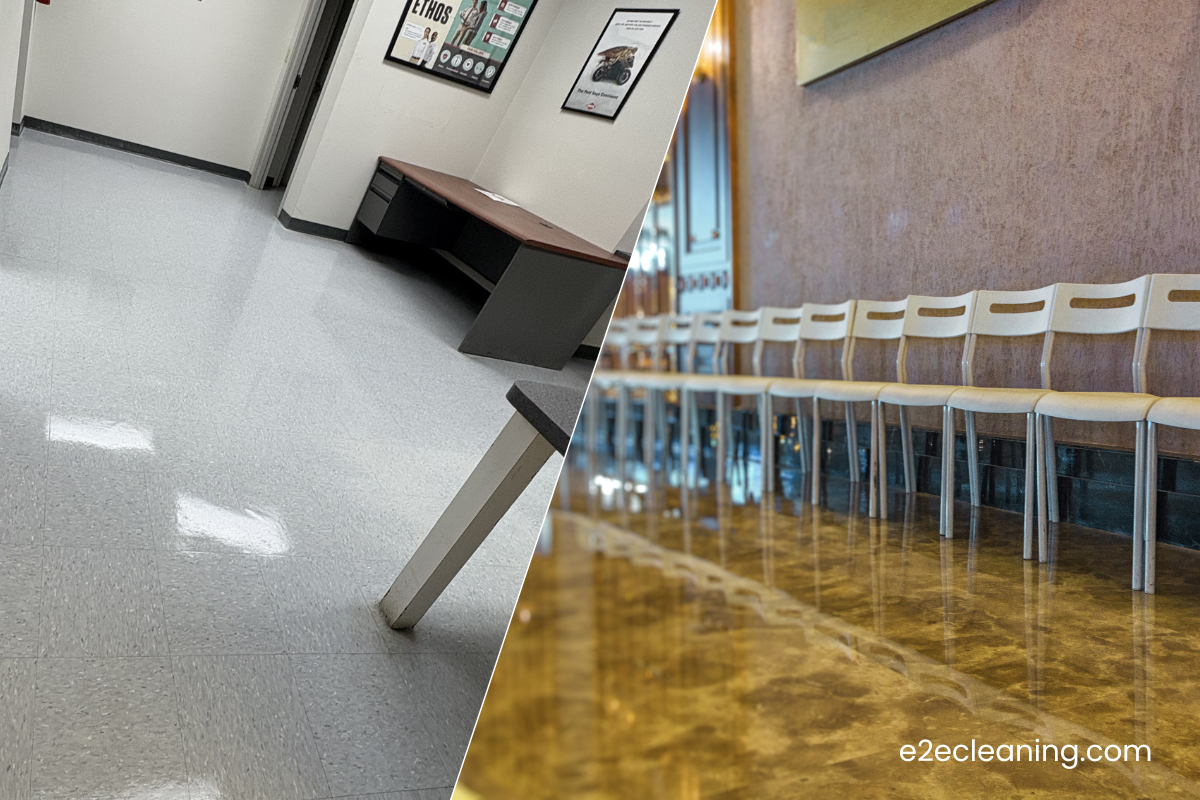
For decades, VCT (Vinyl Composition Tile) has been the most popular commercial floor. You’ve walked on it thousands of times without even thinking about it in schools, hospitals, and stores. That’s the point.
It costs between $0.50 and $2.00 per square foot to install, and it’s easy to replace tiles one at a time. There are enough colors and patterns to match any room. It makes sense on paper for a business that wants to keep an eye on its costs.
The problem is that VCT tiles are porous. It needs to be stripped and waxed regularly to stay safe, and in Florida’s humid climate, you have to do that more often than you would up north.
The floor gets worse quickly if you don’t do the maintenance cycle. The glue can fail if the slab is wet, and the tiles will start to lift, which is a safety problem.
VCT lasts 10 to 15 years if done right. If you don’t do it right or keep it up, you’ll need to replace it in five years.
Epoxy: Higher Upfront, Lower Headache Long-Term
Epoxy isn’t a tile; it’s a resin coating that sticks directly to your concrete slab and dries into a smooth, non-porous surface. There are no grout lines. No tile edges that a pallet jack can catch. No cycles of wax.
Depending on the slab condition and finish required, installation typically runs between $3.00 and $12.00 per square foot. More than VCT, yes. But if your facility deals with chemical spills, heavy rolling loads, or needs a surface that a mop can handle quickly, epoxy earns that cost back.
It’s easy to keep up with day-to-day maintenance: just sweep up loose dirt and mop with a cleaner that doesn’t change the pH level. No stripping. No schedule for waxing. No crew spent hours making the floor look good. For most commercial buildings, the full maintenance cycle is to reseal every 3 to 5 years.
A Florida commercial space with a properly installed epoxy floor can last 15 to 20 years with very little maintenance. That math works out for any facility that has a lot of work to do.
Florida Changes the Equation
What works fine in a warehouse in Ohio can start failing in a Tampa facility in a year or less if you ignore slab moisture.
Florida slabs hold moisture. Vapor moves through concrete constantly, and if your VCT adhesive isn’t rated for it, tiles will start lifting.
Same goes for epoxy. Skip the moisture test before application and bubbles and peeling show up within months. Both failures are avoidable, but only if you account for local conditions before the work starts.
Florida means more frequent stripping and waxing of floors for VCT, especially in busy Tampa facilities. For epoxy, this means preparing the slab correctly and hiring a professional installer who knows how to cure it in humid conditions. Cut corners on either and you end up buying the same floor twice.
Which Floor Fits Your Industry?
Here’s a quick look at the busiest business areas in Florida:
| Industry | Industry Best Option | Real Reason |
| Healthcare / Medical | Epoxy (clinical), VCT (admin) | Sterile zones need seamless, non-porous surfaces. Admin areas can run VCT fine. |
| Retail / Shopping | VCT | VCT tiles costs less and replaces easily, tile by tile, which matters in large facilities that get reconfigured often. |
| Warehouses / Logistics | Epoxy | VCT tiles won’t last with pallet jacks, forklifts, or chemical drips. |
| Hospitality / Hotels | Both | VCT in hallways and epoxy in kitchens and service areas. |
| Food Service / Kitchens | Urethane Cement or Epoxy | Grease, heat, and constant wetness. Epoxy works, but urethane cement is stronger. |
| Schools / Institutions | VCT | Budget-friendly, with a proven track record and easy tile swaps when parts wear out. |
Your Lease Length and Facility Type Should Drive Your Flooring Decision
Not every facility has the same problem. A restaurant kitchen deals with grease, moisture, and daily health inspections. A medical office needs seamless surfaces that clean fast and don’t harbor bacteria. A warehouse prioritizes durability under heavy rolling loads. A retail center lives and dies by appearance under constant foot traffic.
Before the length of the lease is even brought up, each one points to a different answer.
Epoxy can handle a lot of work without asking for much in return at places that deal with chemicals, heavy machinery, or strict sanitation rules. VCT makes more sense for retail spaces or offices that change their layouts often because it is more flexible and costs less up front.
The next thing to think about is the lease.
VCT tile stripping and waxing usually costs between $0.20 and $0.50 per square foot every 6 to 12 months in a 10,000-square-foot Florida building. The “cheap” floor doesn’t stay cheap for long. To keep epoxy in good shape, all you have to do is sweep, mop, and reseal it every three to five years. Most owners see their investment pay off in 4 to 6 years for long-term leases or buildings they live in.
Need flexibility or a short-term lease? It makes sense to use VCT tiles. Are you in charge of a facility you want to keep? Epoxy is cheaper in the long run.
Quick Answers
What’s the best cleaner for epoxy floors?
Warm water with a pH-neutral cleaner. It works, Simple Green. Don’t use vinegar or citrus-based products because the acid will dull the finish over time. Also, no harsh scrubbing pads. Epoxy is strong, but the top coat isn’t unbreakable.
When should you NOT use epoxy?
There are two situations: concrete that hasn’t cured for at least 28 days or a slab with moisture pushing up from below. The latter happens more often in Florida than most people think. The epoxy comes apart in both cases.
Before they start, ask your contractor for the results of the moisture test. No job without a test.
What’s better than epoxy in extreme conditions?
Cement made of urethane. Urethane cement lasts longer than regular epoxy in places like commercial kitchens, food processing plants, and anywhere else where there is a lot of moisture, thermal shock, or harsh chemicals. In tough conditions, it’s one of the best types of industrial flooring that Florida contractors use.
How often should VCT floors be stripped and waxed?
Most commercial VCT floors need a full strip and wax every 6 to 12 months. In high-traffic or humid environments like Florida, that cycle often shortens to every 3 to 6 months. Skipping maintenance doesn’t save money. The finish wears down, dirt embeds, and eventually you’re doing a more intensive refinish just to get back to baseline.
Why are my VCT tiles lifting?
Most of the time, it’s moisture. Over time, Florida slab vapor transmission breaks down the glue, causing the tiles to lift at the edges. Before you put anything back on the slab, have it tested for moisture. Putting new tiles on a wet slab will only make the problem worse.
Pick the Floor That Fits the Work, Not Just the Price Tag
VCT and epoxy are both good choices if you use them in the right place. Most facility managers make the mistake of only looking at the cost of installation and not thinking about how Florida’s weather and their specific business will affect that floor over the next ten years.
VCT is a good choice for budget-conscious facilities with multiple rooms that need to be able to change.
Epoxy is a surface that is easy to clean and lasts a long time, making it great for operations that need a lot of use.
Not sure which one your building really needs? A quick look at the floor on site before you buy can help you avoid a costly mistake.
Get a Free Floor Check in Tampa
E2E Cleaning Services takes care of professional floor stripping, waxing, and hard surface maintenance all over the Tampa Bay area. Get in touch with us for a free on-site assessment if your floors, whether they are VCT or epoxy, need work.