By Jonathan Alonso, CMO and Co-Founder of E2E Cleaning
I recently attended an IFMA Lunch and Learn in Orlando focused on facility culture, leadership, and accountability. I went in expecting a good facilities conversation. I left thinking about how much of this connects to the way E2E supports facility managers every day.
The room was full of people who understand that buildings do not run on paper alone. They run on people, communication, standards, vendors, budgets, emergencies, and the small daily decisions that either protect the building experience or slowly wear it down.
That was my biggest takeaway: facility culture is not abstract. You can see it in the building.
You see it when a work order gets handled with ownership instead of being passed around. You see it when cleaning, maintenance, security, finance, and operations talk before a small issue becomes a complaint. You see it when vendors understand the standard instead of guessing what the facility manager expects.
That is why this conversation from the Greater Orlando Chapter of IFMA stood out to me. IFMA Orlando gives facility professionals a place to learn, share, and talk honestly about the work behind the building experience.
For E2E Cleaning, this topic is personal. Cleaning is one of the most visible parts of facility culture because everyone in the building experiences it. Tenants notice it. Employees notice it. Students notice it. Guests notice it. Leadership notices it when complaints start coming in.
Our job is to help facility managers make that part of the operation more consistent, more accountable, and less reactive.
What I learned: culture is built through daily standards
One of the clearest lessons from the discussion was that culture is built through what leaders repeat, correct, reward, and allow.
That matters in facilities because the work crosses so many teams. A single property may involve internal staff, cleaning crews, security, maintenance, contractors, finance, executives, tenants, students, patients, visitors, and vendors. If every group works from a different expectation, the building feels inconsistent.
I kept thinking about how often facility managers are expected to hold all of that together.
They are managing budgets, service expectations, vendor performance, safety concerns, complaints, seasonal pressure, and leadership requests. Then, when something goes wrong, the building makes it visible fast.
A vague culture sounds like this:
- "That is not my job."
- "Nobody told us that changed."
- "We will deal with it when someone complains."
- "The vendor should have known."
- "Finance approved the budget, but operations owns the fallout."
A stronger culture sounds different:
- "Here is the standard."
- "Here is who owns the next step."
- "Here is how we respond when something is missed."
- "Here is how vendors and internal teams communicate."
- "Here is what we do before the complaint reaches leadership."
That is not theory. Facility managers can measure it in response times, fewer repeat complaints, better walkthroughs, cleaner restrooms, safer floors, faster resets, and more trust between teams.
What I learned: vendors are part of the facility culture
Another point that stayed with me is that culture does not stop with the internal team.
Vendors shape how the building feels. Cleaning crews, specialty contractors, floor care teams, day porters, security teams, HVAC partners, landscaping crews, and emergency response teams all affect the way people judge a facility.
That means vendor accountability has to be part of the culture.
At E2E, we see how quickly things break down when the expectations are not written down. A facility manager thinks a task is included. The vendor thinks it is outside the scope. A missed item turns into frustration. Then the relationship becomes reactive.
A clear scope changes that.
A cleaning partner should understand the service standard, the schedule, the escalation path, the communication rhythm, and the difference between routine work and specialty work. The facility team should know what is included, what is excluded, who supplies consumables, how quality is checked, and who gets called when something changes.
That is where E2E helps facility managers. We do not want cleaning to feel like a mystery. We walk the building, define the scope, identify the pressure points, and help build a cleaning plan that the facility team can actually manage.
For example, a day porter working during business hours can support the culture of a facility by keeping restrooms stocked, responding to spills, resetting common areas, touching up entry glass, and removing trash before it becomes visible to occupants. That service works best when the porter knows the building priorities and the facility manager has a clear feedback loop.
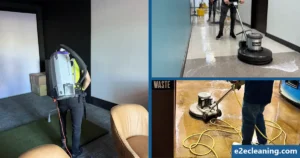
The same is true for recurring janitorial service. A nightly crew can do better work when the standard is specific: which areas matter most, which tasks happen daily, which tasks happen weekly, which items need inspection, and which issues require a call instead of a note.
What I learned: pressure reveals the real operating system
The panel also made me think about what happens when a facility is under pressure.
That part hit home because we work in Florida. Hurricanes happen. Events run long. Power outages happen. Projects turn over late. Budgets shift. Buildings get more traffic than expected. A small service gap can become visible to everyone.
In those moments, culture stops being a phrase and becomes a response.
Teams either solve problems early or wait for direction. Departments either coordinate or protect their own lane. Vendors either communicate quickly or disappear until the next invoice. Leaders either bring calm or add confusion.
The Federal Emergency Management Agency’s Ready Business resources are a useful reminder that preparation is part of continuity. Facility leaders do not need every possible answer in advance, but they do need roles, communication channels, vendor contacts, and recovery priorities before the pressure hits.
Cleaning and facility support are part of that readiness.
After a storm, event, outage, construction turnover, or high traffic period, the building has to reset. Floors, restrooms, entryways, trash areas, common spaces, and back of house areas all affect how quickly the property feels usable again. In Florida, that may also mean planning for storm cleanup before hurricane season puts the building under stress.
That is one of the areas where E2E can help facility managers plan ahead instead of reacting after the building is already under pressure.
What I learned: "not my job" can damage trust fast
One phrase came up in the discussion that every facility leader knows: "not my job."
Sometimes people say it out loud. Most of the time, it shows up in behavior.
A request gets routed with no context. A vendor sees a problem but does not report it. A department protects its own process while the occupant feels the pain. A small issue sits untouched because the person who noticed it was not the person assigned to fix it.
A facility cannot run well that way.
That does not mean everyone owns everything. It means people understand how to move the issue to the right owner while staying helpful.
For cleaning teams, this matters every day. A cleaner may notice a leak, a broken dispenser, an odor issue, a safety hazard, or a pattern of misuse before the facility manager sees it. If the culture rewards communication, that observation becomes useful. If the culture punishes people for speaking up, the issue waits until it becomes a complaint.
This is where I believe a good cleaning partner can bring more value than the checklist shows.
Yes, the checklist matters. Restrooms need to be cleaned. Floors need to be maintained. Trash needs to be removed. But a good partner also notices what affects the building experience and communicates it clearly.
What I learned: every building needs its own plan
Another idea from the panel was that multi-site, multi-county, and multi-tenant environments need shared direction, but every building cannot be managed like it is identical.
That is true for cleaning too.
A school does not operate like a warehouse. A medical office does not operate like a restaurant. A church does not operate like a dealership. A corporate office does not operate like an industrial facility.
The culture has to start with the people using and maintaining the space.
These are the questions I think facility managers should ask before updating a cleaning plan:
- Who is in the building each day?
- When is traffic heaviest?
- Which areas create complaints fastest?
- Which tasks affect safety, comfort, and first impressions?
- Which teams need to coordinate before a service change is rolled out?
- Which areas need daily attention versus periodic specialty work?
Those questions make the cleaning plan practical. They also help avoid a generic scope that looks fine on paper but fails inside the actual building.
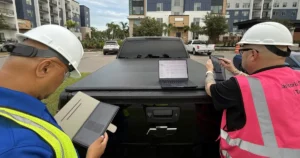
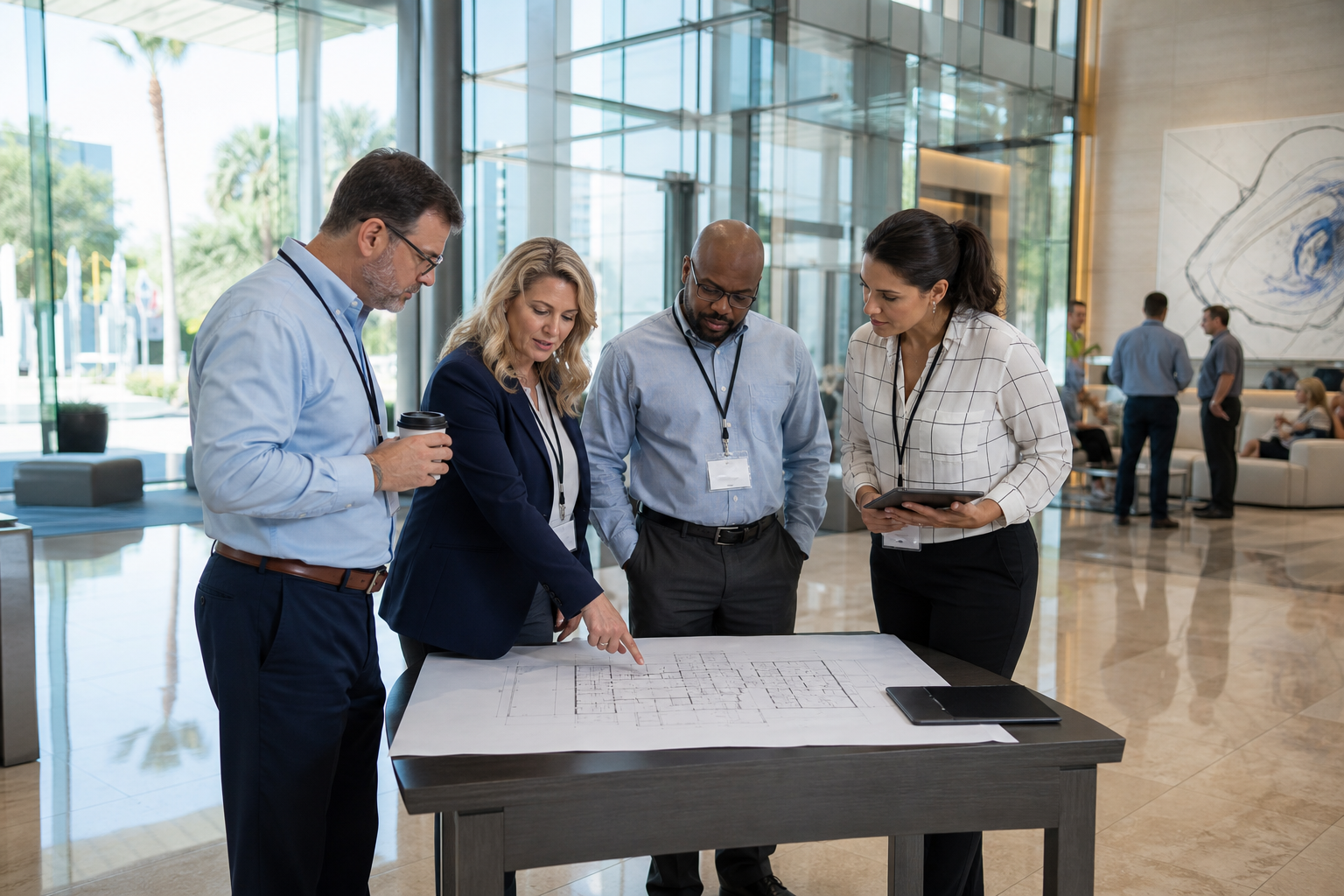
That is why E2E starts with walkthroughs and scopes. The walkthrough is where the facility culture becomes practical. It helps define what matters, who owns it, what needs to happen daily, what needs periodic attention, and what should be escalated before it becomes a bigger issue.
How E2E helps facility managers
The International Facility Management Association describes facility management as work that supports the functionality, comfort, safety, and efficiency of the built environment. I like that definition because it places cleaning where it belongs: inside the larger facility conversation.
A clean building affects comfort.
A stocked restroom affects trust.
A maintained floor affects safety and appearance.
A responsive day porter affects the way people experience the building during the day.
A post-event or post-storm cleanup affects how quickly the space returns to normal.
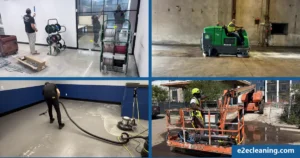
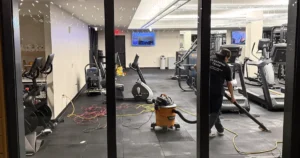
E2E is here to help facility managers make that part of the operation clearer and easier to manage. We support commercial properties across Central and Southwest Florida, including Orlando, with janitorial service, day porter support, post-event cleaning, storm cleanup, floor care, warehouse cleaning in Orlando, and other commercial cleaning services.
Our goal is not just to send a crew and hope the scope is right. Our goal is to understand the building, build the right scope, communicate clearly, and help the facility manager protect the experience people have inside that space.
Questions I brought back from the IFMA Orlando discussion
If you manage a facility, lead vendors, or support building operations, these are the questions I would bring back to your team:
- Do our teams know what good service looks like in this building?
- Do our vendors understand the same standard our internal team uses?
- Are cleaning, security, maintenance, finance, and operations communicating early enough?
- Do we have a process for missed items, complaints, and urgent changes?
- Are our expectations written down in scopes, checklists, and walkthrough notes?
- Do we prepare for pressure moments before the building is under stress?
- Are we rewarding ownership or accidentally rewarding silence?
I left the IFMA Lunch and Learn with a deeper respect for the facility managers who carry this work every day. The building experience depends on their leadership, but it also depends on the partners around them.
That is where E2E wants to be helpful.
If your facility culture is being tested by complaints, inconsistent service, vendor gaps, or unclear standards, start with the building itself.
Walk the space.
Write the standard.
Clarify the scope.
Then hold the team and the vendors to the same expectation.
E2E Cleaning can help you build the cleaning side of that plan. Request a free quote or call (813) 819-0221 to schedule a walkthrough.