A commercial cleaning proposal, written in response to an RFP (Request for Proposal), should show exactly how the cleaning company will service the building, staff the work, manage supplies, document quality, handle safety, and communicate when something changes.
A strong response does more than answer questions. It helps the buyer see whether the bidder understands the facility and what the RFP is asking for.
Many janitorial bids look similar on the surface. They may include a monthly price, a task list, and a few company paragraphs.
The risk sits in what is missing: unclear production assumptions, weak supervision, vague supply language, no transition plan, no backup coverage, and no process for quality issues after service begins.
For property managers, operations leaders, healthcare and financial offices, schools, retail teams, and multi-location businesses, the RFP response is a preview of the working relationship.
If the response is vague before the contract is awarded, the service is likely to feel vague after the crew starts.
Start with a clear understanding of the facility
The first section of the response should prove that the bidder understands what is being cleaned. Square footage matters, but it is rarely enough by itself.
A useful response references facility type, operating hours, traffic patterns, public-facing areas, flooring, secure areas, tenant expectations, and any areas that need special scheduling.
Buyers should look for signs that the bidder walked the space or studied the RFP carefully.
Good responses name specific areas, such as entrances, restrooms, breakrooms, conference rooms, teller or reception areas, corridors, glass, and trash flow, along with recurring pain points when those details are relevant.
Generic language is a warning sign. The cleaning company should be bidding the building, not a template.
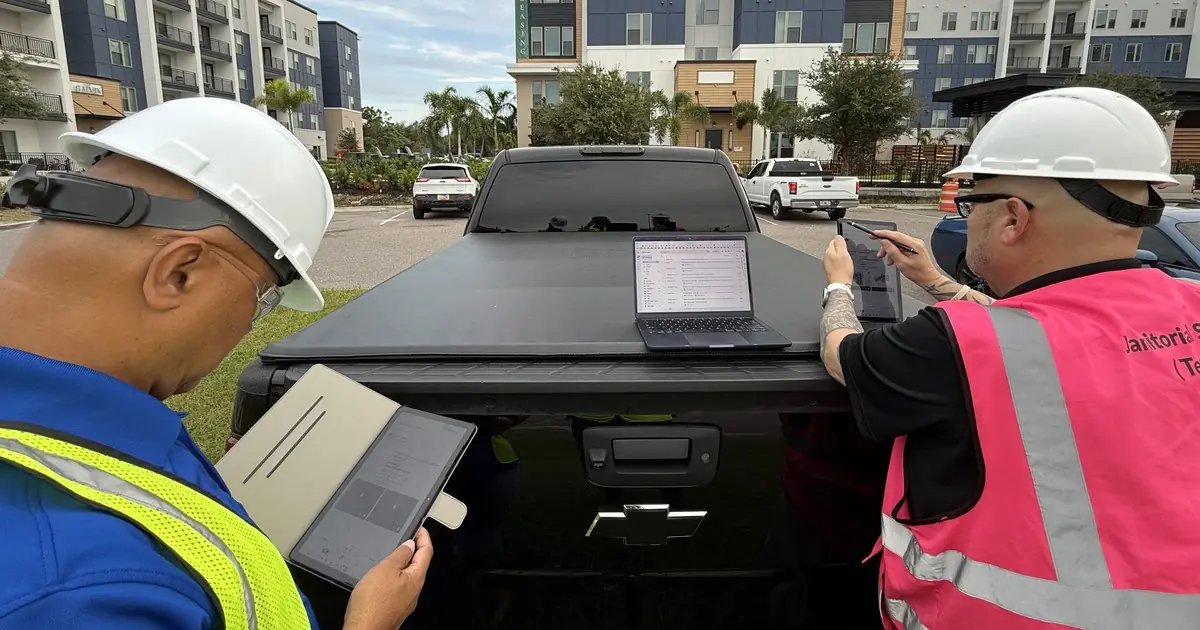
E2E starts a bid with a walkthrough. Restroom fixture counts, layout, elevator access, how far the trash has to travel, after-hours entry, and floor condition all shape the scope, and a quiet admin office calls for a different routine than a public-facing lobby.
The written scope comes out of those notes, and it is what the crew and the client check the work against.
If the RFP covers several locations, the response should explain how the company will keep service consistent without pretending every site is identical.
Multi-location cleaning requires a common standard, but each site may have different traffic, access rules, soil load (how quickly floors and surfaces get dirty), restroom volume, or floor care needs.
Define the recurring scope in plain language
A strong RFP response should translate the cleaning scope into plain service expectations. The buyer should be able to see what gets cleaned, how often, and which tasks are routine, periodic, or by request.
Recurring janitorial work may cover trash removal, restroom cleaning, fixture wiping, breakroom cleaning, vacuuming, mopping, dusting, spot cleaning, entry glass, touchpoint cleaning, and supply restocking.
Larger facilities may need day porter coverage, high dusting, interior glass, floor care, post-event cleaning, or periodic deep cleaning.
The response should also define what is excluded or separately priced. That may include exterior pressure washing, window washing, carpet extraction, strip and wax, construction debris, biohazard situations, emergency cleanup, or specialty restoration.
Exclusions do not weaken a proposal. They prevent disputes by making the line clear.
E2E’s janitorial services and commercial cleaning services are built around written expectations because a cleaning relationship should not depend on assumptions.
For buyers still shaping an RFP, E2E’s commercial cleaning scope of work resource can help turn building needs into a clearer service outline.
Explain labor assumptions without exposing the building to shortcuts
The labor plan is one of the most important parts of a commercial cleaning RFP response. The bidder should explain how the proposed schedule matches the required work.
The response does not need to reveal private pricing math, but it should show that the company has considered task frequency, production time, building access, travel between areas, supervision, and periodic work.
A good response should answer practical questions:
- Who is assigned to the site?
- What work is handled during each visit?
- Which tasks need a separate floor crew or periodic crew?
- Who supervises the account?
- What happens when an employee is out?
- How does the company protect service continuity if access, weather, events, or tenant needs change?
For multi-location clients, the response should also cover route logic and account oversight. Each location may need its own scope, and that is fine as long as every scope is written down.
The contractor then knows what is expected at each site, and the service standard does not drift from one location to the next.
Show the quality assurance process
A buyer reading an RFP response wants to know what happens when a restroom is missed or a floor is left streaked.
The quality assurance section should explain how issues are found, documented, corrected, and tracked over time.
That may include supervisor inspections, site checklists, client walkthroughs, photo documentation where appropriate, issue logs, recurring review meetings, and escalation paths.
E2E’s guide to commercial cleaning documentation shows what those records can look like.
Someone also has to own the follow-up, and the response should say who.
When a missed trash pull, a supply problem, or a floor issue comes in, the buyer should know who picks it up and how it moves from complaint to correction.
The inspection checklist and the written scope have to match.
If the checklist scores tasks nobody agreed to, every inspection turns into an argument about what the contract covers. If the scope lists tasks nobody checks, there is no way to know whether the work happened.
The response should show that each checklist item comes from the scope, and that each recurring task in the scope has a way to be checked.
Cover supplies, consumables, and restocking rules
Supplies can create friction if the RFP response does not define them. Buyers should know whether the cleaning company provides cleaning chemicals, paper products, liners, soap, sanitizer, dispensers, batteries for dispensers, specialty products, or only labor.
The response should explain whether supplies are included, billed separately, billed as a fixed allowance, or ordered through the client’s vendor.
It should also address substitutions. If a product is out of stock, who approves the replacement? If a restroom runs through paper faster than expected, how is that handled?
If the facility has green cleaning requirements, fragrance restrictions, or surface-specific chemicals, the response should say where they are documented.
Address safety, access, insurance, and compliance
A commercial cleaning company works inside someone else’s building, often after hours.
The RFP response should explain how the company handles access, keys, alarms, badges, secure rooms, chemical storage, wet floor procedures, incident reporting, and crew conduct.
Safety language should be practical. OSHA’s recommended practices for safety and health programs emphasize management leadership, worker participation, hazard identification, training, and improvement.
A cleaning proposal should connect safety to real site work: wet floors, ladders, chemicals, equipment cords, lifting, disposal, and building access.
The response should also list insurance documentation the company can provide, such as a certificate of insurance when requested.
If the RFP requires background checks, uniforms, identification, training documentation, or site-specific onboarding, the bidder should answer directly.
Include a transition and startup plan
The first month of a new cleaning contract is where many service problems begin. A good RFP response should explain what happens between award and full service.
The transition plan may include a kickoff call, site walkthrough, final scope review, crew assignment, access setup, supply inventory, equipment staging, floor or restroom baseline notes, supervisor introduction, and first-week inspection.
The plan should also state what the cleaning company needs from the client: keys, alarm codes, parking instructions, trash room access, supply locations, tenant rules, emergency contacts, and after-hours procedures.
E2E’s White Glove standard applies here: a clean handoff where the building sees progress and knows who is doing what.
State pricing assumptions and exception handling
Pricing should be clear enough for the buyer to compare bids fairly. A strong response should state what the price includes, what requires approval, and which assumptions affect the proposal.
Common assumptions may involve service frequency, building access, consumables, floor work, after-hours labor, periodic project work, minimum visit requirements, holiday service, event cleanup, and emergency requests.
The response should explain how changes are handled if the scope grows or conditions differ from the RFP.
E2E covers how scope drift leads buyers to outgrow a contract in its guide to when to rethink a commercial cleaning contract.
Clear assumptions mean fewer surprises for the buyer and no need to fix an unrealistic bid later through service cuts or add-on charges.
For buyers, the weakest question is “Which bid is cheapest?”
The better question is:
“Which bid explains the work well enough that we can manage it after award?”
A price without assumptions is hard to trust.
What buyers should expect from E2E Cleaning
E2E Cleaning Services is based in Tampa and serves commercial clients across Florida, including Orlando, St. Petersburg, Clearwater, Wesley Chapel, Land O’ Lakes, Zephyrhills, and beyond.
We service offices, medical facilities, retail spaces, schools, hotels, industrial sites, post-construction projects, HOAs, and multi-location commercial accounts.
For an RFP or proposal request, we can help clarify recurring janitorial needs, day porter services, commercial deep cleaning, post-construction cleaning, floor care, restrooms, supplies, supervision, and quality expectations. We hold our own proposals to that standard: practical enough for procurement and operational enough for the person who has to live with the contract.
E2E is a Tampa Bay Chamber member and was named the 2024 Minority Owned Business of the Year by the Florida SBDC at USF.
If your organization is preparing a janitorial RFP or comparing cleaning proposals, we can review the building’s needs and put together a clear scope. Call (813) 819-0221 or request a free quote.
Commercial cleaning RFP response FAQs
What is the most important part of a commercial cleaning RFP response?
The most important part is the scope. The response should clearly state what will be cleaned, how often, who manages the work, how quality is checked, and what is excluded. Price matters, but price is hard to compare if the scope is vague.
Should a cleaning RFP response include staffing details?
Yes, but at the right level. The buyer should understand the service schedule, supervision, backup coverage, and account management plan. The response does not need to disclose private staffing formulas, but it should show that the labor plan matches the building.
Should supplies be included in a janitorial proposal?
Supplies can be included, billed separately, or purchased by the client. The RFP response should state which model applies and define products, restocking responsibility, substitutions, and approval rules so the building does not run into surprise costs or empty dispensers.
How can facility managers compare commercial cleaning bids fairly?
Compare the written scope, frequency, labor assumptions, QA process, supervision, supplies, safety, transition plan, and exceptions before comparing price. A low bid with unclear assumptions can cost more later if it leaves work uncovered or creates constant service issues.