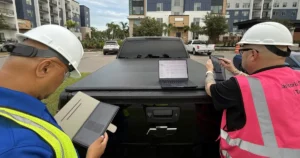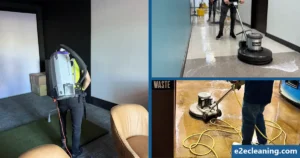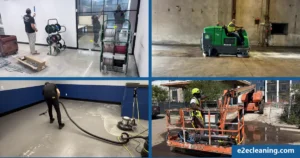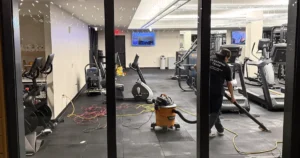
A commercial floor that looks dull, sticky, or blotchy is usually reporting its maintenance history. Old wax, sealer buildup, residue from an incomplete strip, and damage sealed under a previous coat all change what the floor needs. So commercial floor cleaning and restoration should begin with a walkthrough that identifies the surface, the coating history, and the result one visit can realistically reach, before anyone books a machine or quotes a price.
E2E starts every floor-care quote the same way. Find out what the floor has been through, confirm what surface is actually under the finish, and say plainly what a single visit will and will not fix.
What a dull floor is telling you about its history
The floor’s condition is usually shaped by the last company that touched it. Rushed work, the wrong product, or an incomplete strip all get inherited by the next crew, and a floor can end up carrying several layers of finish over old defects, with some sections over-treated and others down to bare protection.
Wax, finish, and sealer are meant to protect a floor. They also hide what is happening beneath them, which is why the visible problem and the real one are often a layer apart.
| What you see | What it usually means |
|---|---|
| Cloudy or yellowed finish | Old finish that has aged, or a recoat laid over residue |
| Patchy or blotchy shine | Uneven application, or new coating over trapped soil |
| Still sticky after mopping | Detergent or finish residue that never rinsed out |
| Dull lanes with bright corners | Traffic wear, with corners still holding the original coats |
| Heavy buildup at edges and baseboards | Years of recoating without a full strip |
| Discoloration below the top coat | Damage covered rather than corrected |
The wrong diagnosis produces the wrong service plan. A contractor may quote a basic cleaning when the floor needs stripping, or quote a full restoration when the floor needs lighter correction and a better maintenance schedule. Buildings that have changed janitorial vendors several times carry the most of this, because the layers stack up in the order they were applied.
A photo rarely shows any of it. Cleaning takes off what sits on the surface, while what stripping and waxing actually removes is the coating itself and the soil trapped inside it. On floors that genuinely need floor stripping and waxing in Tampa, that prep decides how the finish coat holds.
Different surfaces need different restoration methods
A method that improves one floor can damage another, and most commercial buildings hold several surfaces in one footprint. Vinyl composition tile in a corridor behaves differently from epoxy in a Florida building, and both behave differently from the terrazzo at the entrance.
| Surface | Usual restoration path | What the walkthrough checks | What goes wrong when it is skipped |
|---|---|---|---|
| VCT and resilient tile | Strip, seal, finish | Layer count, buildup at edges, soil in the seams | New finish over old residue, blotchy in weeks |
| Terrazzo | Diamond honing, polish, seal | Wax applied over the stone, cracks at the aggregate | Stripping a floor that only needed honing |
| Marble and stone | Honing, polishing, sealing | Etching against abrasion, spill-shaped matte patches | Cleaners that etch the stone further |
| Polished concrete | Re-polish, densify, guard | Densifier history, moisture at the slab | Coatings that never bond on an unsealed slab |
| Grout and hard tile | Deep clean, color seal | Joint depth, prior sealer, drainage | Sealer trapped over soil in the joint |
| Commercial carpet | Extraction, edge treatment | Wicking, transitions to hard floor | Moisture pushed into hard-floor edges |
Terrazzo and polished concrete take different maintenance even when they look alike at the entrance. E2E runs terrazzo floor polishing, marble floor polishing, concrete floor polishing, and commercial carpet cleaning as separate processes, because the walkthrough decides which one each surface gets.
When a test section makes sense
A test area of roughly 100 square feet answers what a walkthrough cannot.
Test sections earn their time when the coating history is unknown, buildup is visible, or there are signs that previous work failed. The patch shows whether the buildup comes off cleanly, whether the discoloration sits above or below the surface, and whether a new coating will bond.
A test section usually saves time, because it catches the wrong approach on a 10 by 10 patch instead of the whole floor.
Evaluation protects safety and daily operations
Floor restoration changes how people move through the building while the work is underway.
Under OSHA’s walking-working surfaces rule, 29 CFR 1910.22, the employer must keep passageways, service rooms and walking-working surfaces clean, orderly and sanitary, and must keep each workroom floor clean and, to the extent feasible, dry. The same section requires those surfaces to stay free of hazards such as leaks and spills, which is the part that applies while a floor is wet, stripped, or curing.
So the plan has to name which walk paths stay open, how long a section stays closed, and whether the work runs after hours. A better finish is worth less if the process shuts a corridor nobody could spare.
What one visit can and cannot fix
Some floors improve dramatically in one service. Some do not. It becomes a problem when nobody explains that before the work starts.
A neglected floor may need restoration. A poorly maintained floor may need correction before restoration. A floor with the wrong product history may need testing before either one.
That protects the customer from an oversold promise, and it protects the contractor from underbidding a job that is harder than it looks.
How E2E evaluates a commercial floor
E2E’s floor-care quotes start from the condition of the surface in front of us.
On Florida slab-on-grade buildings, moisture moving up through the slab is a live variable for anything that has to bond to concrete, and summer indoor humidity stretches the cure window on finish coats. Both go in the walkthrough notes, because they decide whether a coating holds or lifts in the first month.
The same notes cover traffic pattern, prior maintenance, damage, and the building’s operating hours, for offices, schools, medical offices, retail, hotels, warehouses, and HOA properties.
Frequently asked questions about commercial floor restoration
How do I know if my commercial floor needs restoration or cleaning?
If the floor still looks dull, cloudy, sticky, or uneven after a routine clean, it needs an evaluation for buildup, old finish, trapped soil, or surface damage. Restoration corrects what routine mopping and scrubbing cannot reach.
Should every commercial floor be stripped and waxed?
No. Stripping and waxing suits some resilient floor systems and is the wrong call on others. Stone, terrazzo, polished concrete, and carpet each take a different process, decided by the surface and its current condition.
Why does floor restoration cost more than regular cleaning?
Restoration takes more labor, prep, equipment, and drying time. The crew may have to remove old coatings, correct uneven finish, test small areas, and work around the building’s hours.
How often should a commercial floor be evaluated?
High-traffic facilities should review floor condition a few times a year, and before any major restoration work. Entrances, corridors, restrooms, and food-service areas wear first, so they are worth checking more often than the rest of the building.
Start with the right diagnosis
Commercial floor restoration comes down to reading the floor correctly before choosing the method. The surface, its coating history, and the building’s hours decide what a crew can reach in one visit.
If your floor has gone dull, sticky, or uneven and the last clean did not move it, send us the square footage and the floor types and we will walk it. Request a free estimate or call (813) 819-0221 to schedule a walkthrough.