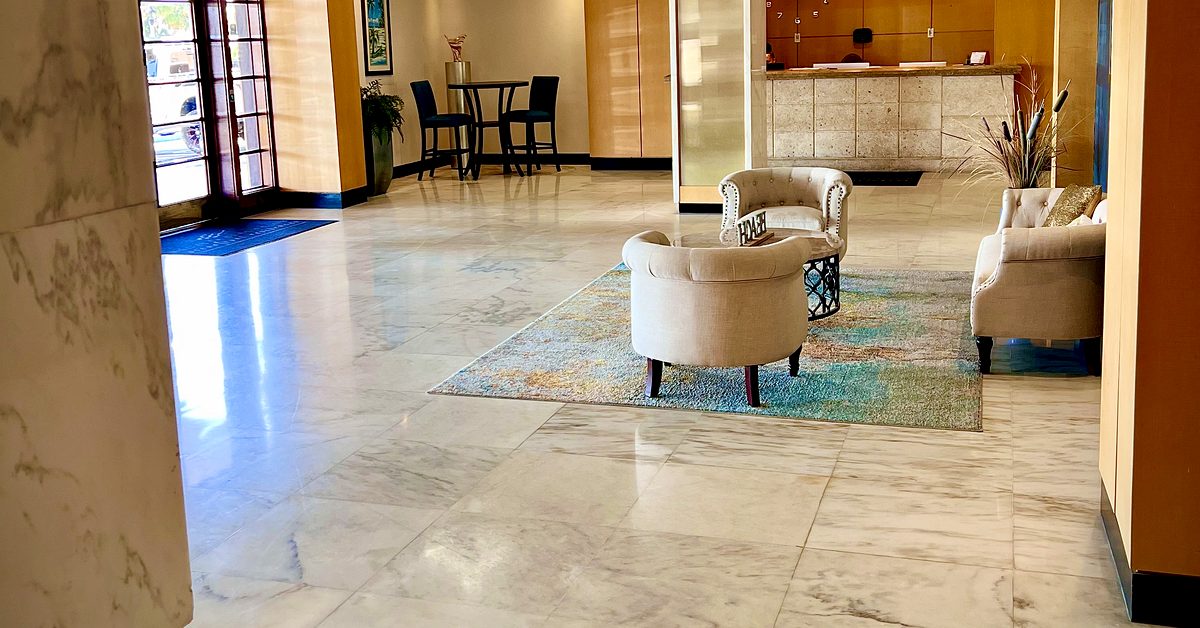
Commercial marble floors need professional polishing when they lose their shine, show traffic lanes, or stop responding to normal cleaning.
In Florida the damage starts at the door. Wet season runs June through September and tracks water and grit across the entry every afternoon, and coastal properties add fine sand that works like sandpaper underfoot. Lobbies, elevator banks, and clubhouse entries take that load first.
Marble can look clean and still look tired. A mop lifts what is sitting on the stone. Surface wear, etching, scratches, and a finish gone flat under the lights all sit in the stone itself, a layer below anything a mop reaches.
E2E Cleaning Services provides Tampa marble floor polishing for commercial properties, and every job starts with a walkthrough.
What commercial marble polishing does
Polishing works the stone, not the dirt on top of it. The surface gets cleaned, then honed if the wear runs deep enough to need it, then polished to whatever level of shine the room calls for. A hotel lobby and a back corridor rarely want the same finish.
How often commercial marble needs polishing depends on what crosses it.
| Area | Typical polishing cadence |
|---|---|
| Hotel or office main entry and lobby | Quarterly |
| Elevator banks and primary corridors | 2 to 3 times a year |
| Clubhouse and amenity space | 1 to 2 times a year |
| Executive floors and low-traffic showrooms | Once a year |
Those are starting points. Door count, matting depth at each entry, and whether the stone is sealed all move the interval.
7 signs your Tampa marble floors need polishing
1. The floor looks clean but flat
A marble floor can be perfectly clean and still look dead under lobby lighting. It shows first at the entrance and the reception desk, where the light is strongest and people are already looking down. If mopping stopped bringing the finish back a while ago, what you are looking at is surface wear rather than soil.
2. Traffic lanes stay visible
Everyone walks roughly the same line through a building. Door, reception, elevator, back out again. Carts and luggage follow it too, and after a few years that line is visibly duller than the stone three feet to either side of it.
Once a lane shows after cleaning, no amount of routine work takes it out.
E2E’s janitorial services cover the daily side of that. The lane itself is specialty work.
3. Mop marks and residue show too easily
This one shows up after cleaning, not before. The crew finishes the floor, and within a few hours it is showing footprints, mop marks and streaks again. Worn stone is more porous and less even than polished stone, so it holds residue instead of shedding it.
The Natural Stone Institute recommends neutral cleaner, stone soap or a mild dishwashing detergent with warm water, and warns that too much of any of them leaves film and streaks.
4. Dull spots that do not wipe away
Etching is chemical damage, not soil. Marble is a calcareous stone, mostly calcium carbonate, so anything acidic reacts with the surface and leaves a dull mark that scrubbing will not lift. In commercial spaces it usually traces back to drinks, restroom products, or a cleaner that was never meant for natural stone.
Telling etching apart from traffic wear decides the scope, and two checks on a walkthrough settle it.
Wet a section of floor and watch it dry. Haze that vanishes while the floor is wet and comes back as it dries is residue or a failing coating, and the stone underneath is generally sound. Anything still visible on a wet floor is damage in the stone.
Then hold a flashlight low, almost parallel to the surface. Etching reads as a matte patch with a hard edge, shaped like whatever was spilled. Abrasion reads as a soft haze that follows the walking path and fades at the margins, carrying fine parallel scratches in the direction of travel.
That call changes the work. Light etching typically polishes out. Abrasion across a full lane needs honing with progressively finer diamond abrasives before a polish will hold.
5. Someone has already coated or spot-fixed it
Worn marble often gets a coating instead of a repair. A floor finish or a wax goes down over stone that needed honing, and for a few months it looks solved.
The coating gives itself away. It wears through in the traffic lanes first, so the floor turns patchy, hard edges where the finish has broken and softer ground where it still holds. Spot repairs do the same at a smaller scale.
Use the same wet check from the section above. A haze that lifts while the floor is wet and returns as it dries is the coating, not the marble. Stripping it is usually step one, and the stone underneath is often in better shape than the floor looked.
6. The cleaning crew is working harder
Worn stone quietly adds labor. The lobby that used to take twenty minutes starts taking thirty. The crew goes back over the same patch twice, and someone eventually asks for a stronger product because the normal one stopped working.
The labor line usually moves before anyone writes the floor up as a problem. E2E’s commercial floor cleaning and restoration work covers marble alongside the other hard surfaces in the same building.
7. The fix keeps getting more expensive
Marble does not hold still while a decision is pending. Light etching and early dullness still come back with polishing. Once a lane has worn through the polished surface, the same floor needs honing first, which means more passes, more abrasive steps and more hours on site.
The same curve runs on every hard surface in the building. A property deferring marble polishing in the lobby is usually also deferring terrazzo floor polishing in Tampa in the older common areas, limestone floor polishing in the amenity spaces and floor stripping and waxing in the VCT corridors.
Pricing them together keeps one crew from using a product on one surface that damages the next.
Marble floor care and building safety
A documented floor-care plan gives property teams an early look at worn or slippery areas before they turn into a larger issue. OSHA’s walking-working surfaces guidance puts falls, both from height and on the same level, among the leading causes of serious workplace injury, and 29 CFR 1910.22(d) requires that walking-working surfaces be inspected regularly and maintained in a safe condition.
Schedule a marble floor walkthrough in Tampa
If the floors are dull, etched, or just harder to keep looking right than they used to be, a walkthrough will tell you which of these you are actually dealing with.
Start with the main Tampa marble floor polishing service page, or request a free quote. You can also call E2E Cleaning Services at (813) 819-0221.
FAQ
Are marble floors high maintenance?
Marble needs the right products used consistently, which is a lower workload than most teams expect. Neutral products, good walk-off mats, and quick spill response keep marble presentable. Most of what gets called high maintenance is really a product problem, which is worth sorting out before changing the cleaning routine.
Is marble polishing the same as regular floor cleaning?
No. Regular cleaning removes daily soil and spills from the surface. Marble polishing is specialty work aimed at dullness, wear, and etching in the stone itself, which is why most commercial properties end up scheduling both.
What should commercial teams avoid using on marble?
Anything acidic. Vinegar, lemon-based products, and most descaling or hard-water bathroom cleaners will etch marble on contact, and abrasive pads do the same damage mechanically. Neutral-pH cleaner and warm water cover routine marble care between professional visits.